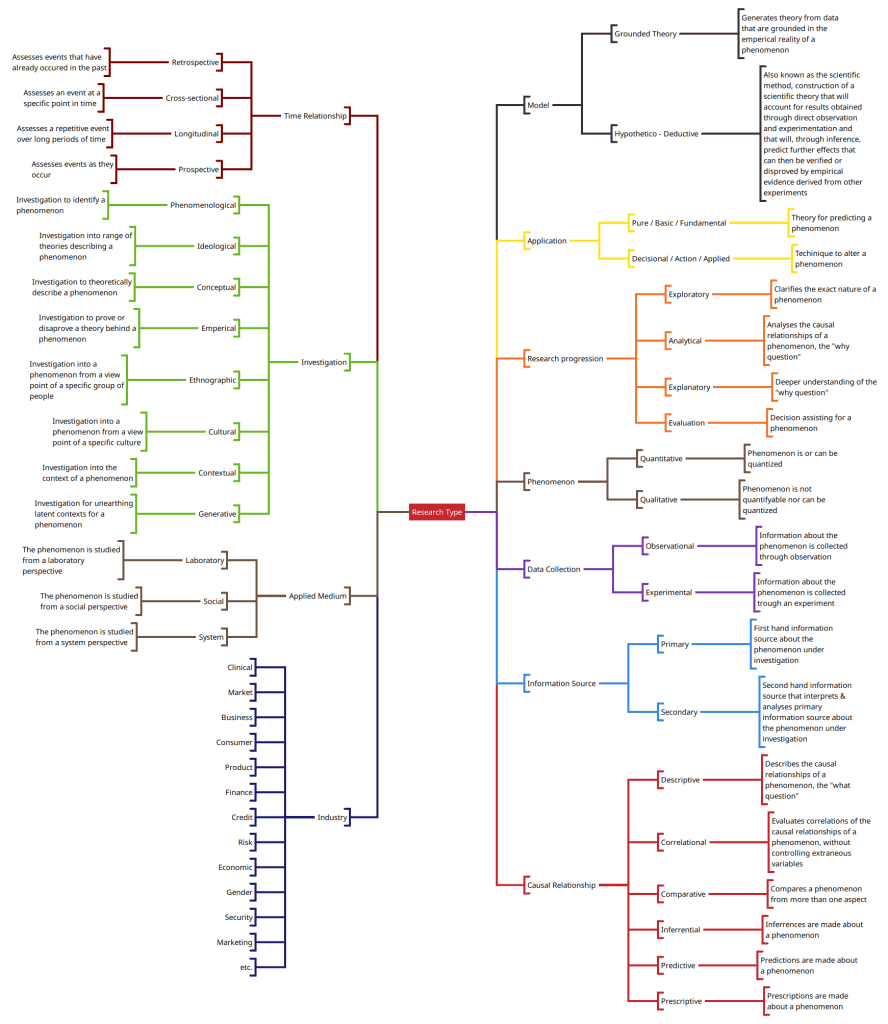
As depicted in the figure above, I have described various types of research based on different categories, classes, groups, semantics and nomenclatures. A total of eleven such parameters have been evaluated. These eleven identifiers are listed below, since you are currently working in the education industry as an associate / assistant professor for an Indian higher education college / university and have already selected a topic that is data driven, my advice for choosing the best research type is as follows:
- Research model being used : For an educationalist the best research model to choose is Hypothetico – Deductive, – Also known as the scientific method, in which construction of a scientific theory is done in such a manner, that it will account for results obtained through direct observation and experimentation and that will, through inference, predict further effects that can then be verified or disproved by empirical evidence derived from other experiments.
- Application of the intended research : For a novice / first time researcher it is safest to conduct a decisional / action / applied research, in which you would investigate a – technique to alter a phenomenon rather than develop a theory for predicting a phenomenon
- Current stage of research progression : Depending on the topic that you have selected, that topic’s research ecosystem and the stage of current research you can choose any of the four types of research namely, exploratory, analytical, explanatory or evaluation. However as research goes from exploratory towards evaluation the scientific rigour required also increases which also increases the amount of resources required to justify the research.
- Nature of the research phenomenon being investigated : As discussed in the topic selection article, data driven research is known as quantitative research, its advantages have also been highlighted in that article and why it is beneficial for a Ph.D. scholar like you.
- Process through which research data will be collected : Although first time researchers should confine themselves to observational studies as they require less rigour in comparison to experimental studies, on the other hand experimental studies require much more careful planning and execution but they also have a higher impact. Depending on the amount of effort you can put in you can also choose a quasi – experimental study. However, in order to drive a quality research you should consider collaborating with a professional statistician before starting your research.
- Key information sources that will be used for research : You should first consider what type of data is already available with you or is within your reach and does not require additional effort. If this is not possible then you should consider that class of data which you can collect with minimal additional effort and if that is also not possible, only then you should consider that data for which you would have to put maximum effort. Generally speaking, sampled secondary data is the easiest to find and obtaining sampled survey data is where you would have to put maximum effort. While selecting the class of data you should also consider qualitative data (non-numerical data) that can be quantified or coded into numerical values though an appropriate approach or technique or method.
- Ways in which causal relationships will be researched : Since, investigating causal relationships require scientific rigour and is mostly impossible without experimental or in its absence mathematical / statistical design, you should refrain yourself from investigating causal relationships and consider researching on various confounding variables that affect your subject of study. However, you should at-least choose to investigate relationships which may not be causal but may be related to your phenomenon of interest. And, in doing so, you should consider a design which enables you to describe, correlate, compare and then make inferences about various related relationships existing in the phenomenon of your research interest.
- Relationship of time with the current research : As a PhD scholar who has a limited amount of time for completing the research, you should refrain from conducting prospective studies. Retrospective and cross-sectional studies are most appropriate; but longitudinal experimental studies can create high impact content.
- Type of investigation that would be carried out for the research : The type of investigation is largely governed by the area of your research, however, most common research types are empirical, ethnographic and cultural.
- Medium through which the research is applied : The applied medium for your research will also be driven by your current resources and accessibility to those resources. All types of researches are fairly common for PhD students.
Whether the research is industry specific : Industry specific research requires certain prescribed guidelines, rules and traditions. It may also incorporate new advancements in research tools and technologies. Both, these points should be well understood by the PhD scholar.

Discover more from Ankit Gupta
Subscribe to get the latest posts sent to your email.